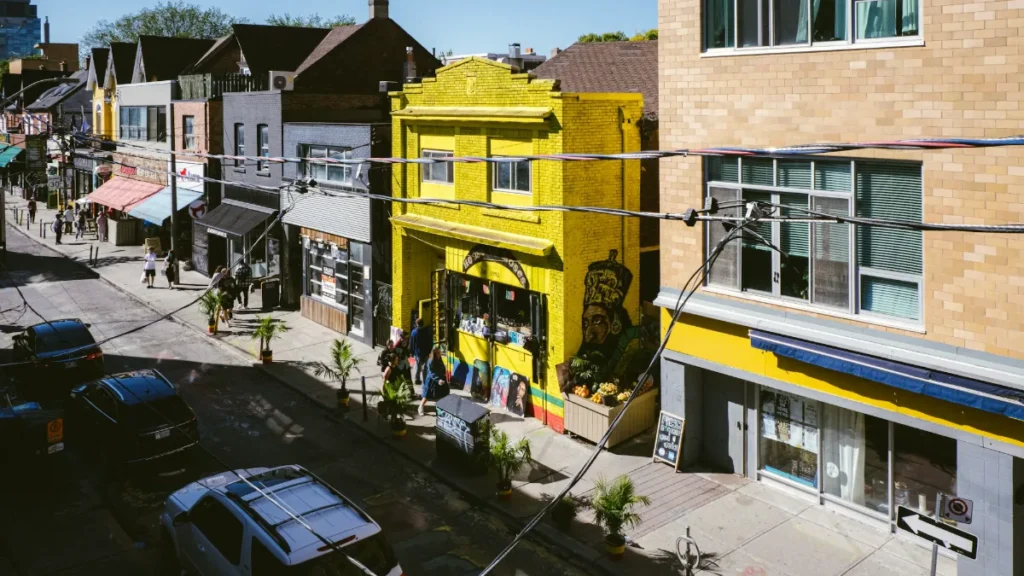
Kensington Market is a compact, walkable downtown Toronto neighbourhood of narrow streets, Victorian row houses turned into shops, vintage clothing stores, cafes, bakeries and food counters from around the world. It sits just west of Spadina Avenue and Chinatown, between College Street and Dundas Street West, and it costs nothing to visit: there are no gates, no tickets and no set opening hours for the neighbourhood itself. Plan on 1 to 3 hours, arrive by streetcar rather than car, and come hungry.
This guide covers what Kensington Market is, when to go, how to get there, what to see and eat, and practical tips for a first visit. Toronto City Tour is an independent guide and does not sell tours or tickets.
Quick facts
- Location: downtown Toronto, bounded by College Street (north), Spadina Avenue (east), Dundas Street West (south) and Bathurst Street (west)
- Main shopping streets: Augusta Avenue, Kensington Avenue, Baldwin Street and Nassau Street
- Cost: free to visit; you pay only for what you buy
- Hours: the neighbourhood is open every day; each shop and restaurant sets its own hours, and most close on December 25 and January 1
- Getting there: 510 Spadina streetcar (Nassau Street stop), 506 Carlton streetcar along College Street, or the 505 Dundas streetcar along Dundas Street West
- Parking: limited paid Green P parking nearby; transit is easier
- Time needed: 1 to 3 hours
- Status: National Historic Site of Canada since 2006
What is Kensington Market?
Kensington Market is a neighbourhood, not a single market hall. It covers about 27 hectares west of Spadina Avenue, and its shops, food counters and cafes are packed into a few blocks of small houses, many of which now have storefronts built onto their front yards. Expect colourful facades, murals on almost every wall and alley, and a mix of grocers, cheese shops, spice stores, vintage clothing, record and book shops, bars and casual places to eat.
Unlike St. Lawrence Market, which is one historic building with stalls under a single roof, Kensington is spread across open streets. That makes it a place to wander rather than a place to tick off. There is no official entrance; most visitors simply walk in from Spadina Avenue or College Street and follow the crowds.
A short history
The land was once part of the estate of George Taylor Denison, who bought it in 1815. The estate was divided into lots in the 1850s, and Irish and Scottish labourers settled in the row houses built later in the century. In the early 1900s, Eastern European Jewish immigrants arrived in large numbers, and by the 1920s the area was widely known as “the Jewish Market”.
Later waves of newcomers followed, including Portuguese families from the Azores in the 1950s and people from the Caribbean, East Asia, Central and South America, East Africa, the Middle East and Southeast Asia. Each group added its own shops and food. Plans drawn up in the 1960s to demolish parts of the area for housing projects were eventually dropped, and the neighbourhood kept its small-scale streets.
Parks Canada designated Kensington Market a National Historic Site in 2006, recognizing it as a place shaped by successive immigrant communities and for its narrow streets, laneways, closely built houses and institutions such as the Kiever and Anshei Minsk synagogues. In 2026, the City of Toronto’s Kensington Market Heritage Conservation District Plan was approved by the Ontario Land Tribunal, adding local heritage protection.
When to visit
Best days and times
Kensington Market is open to walk around any day of the year, but individual shops keep their own hours. Many open in the late morning, and some smaller stores open later or close one day a week. Weekday mornings and early afternoons are the quietest. Weekend afternoons are the busiest, with crowded sidewalks and lineups at popular food counters, which is part of the fun for many visitors but slower going with a stroller.
Pedestrian Sundays
On Pedestrian Sundays, parts of Augusta Avenue, Baldwin Street and Kensington Avenue close to cars, and the streets fill with music, performers, pop-up vendors and people. Local residents and businesses have organized these days since 2004. In 2026 they were held on the last Sunday of the month from June to October (June 28, July 26, August 30, September 27 and October 25), from noon to 7 p.m. Dates for 2027 had not been announced when this guide was written, so check local event listings before you plan around one.
Seasonal events
The Kensington Market Winter Solstice Festival is a long-running community celebration held around December 21, with an evening programme of music, theatre and storytelling by local artists. A jazz festival also takes place in the neighbourhood in early fall. Details and dates change from year to year, so look for current announcements before you go.
By season
Summer and early fall are the liveliest seasons, with patios open and the most foot traffic. Winter is quieter and cold, but cafes, vintage shops and food counters stay open, and the neighbourhood makes a good short outing between indoor sights. For month-by-month weather and events, see our guide to the best time to visit Toronto.
How to get there
By streetcar
Transit is the easiest way to reach Kensington Market. The 510 Spadina streetcar runs along Spadina Avenue between Spadina station (Line 2) and Union Station, and its Nassau Street stop is the one most associated with the market. You can also get off at the College Street or Dundas Street stops on Spadina and walk west.
The 506 Carlton streetcar runs along College Street, along the north edge of the neighbourhood, and the 505 Dundas streetcar runs along Dundas Street West on the south side. An adult TTC fare is $3.30 with a tap of a credit or debit card or PRESTO, and transfers are included for two hours. Check ttc.ca for service changes, as streetcar routes are sometimes replaced by buses during construction.
On foot
From Union Station or the CN Tower, Kensington Market is roughly 2 km north, or about a 25 to 30 minute walk. It is also within easy walking distance of the Art Gallery of Ontario on Dundas Street West, less than 1 km to the east, which makes the two a natural pairing for one day.
By car
Driving is not recommended. The streets are narrow and busy, many are one way, and parking is limited to a few paid Green P lots and street spaces nearby. If you do drive, look for a Green P lot near the edge of the neighbourhood and walk in.
What to see and do
Walk the main streets
Start at Augusta Avenue, the busiest street, and loop through Kensington Avenue, Baldwin Street and Nassau Street. Each block has a different feel: some lean toward food, some toward vintage clothing, and some toward bars and live music. Because the area is small, you can walk all of the main streets in under an hour and then go back to the places that caught your eye.
Murals and street art
Murals cover walls, garage doors and laneways throughout the market, and the side alleys are worth a detour for photos. Art changes over time as new pieces are painted, so what you see will depend on when you visit.
Bellevue Square Park
Bellevue Square Park, on the west side of the market, is the neighbourhood’s green space. It has benches, open lawn and a statue of Toronto-born actor Al Waxman. It is a handy spot to rest, eat a takeaway lunch or let children play.
Vintage and independent shops
Kensington is known across Toronto for second-hand and vintage clothing, as well as independent shops selling records, books, crafts, kitchen goods and imported groceries. Prices vary widely from shop to shop.
What to eat
Food is the main reason many people come. Rather than one food hall, you will find dozens of small counters, bakeries, grocers and casual restaurants, reflecting the communities that have lived here. Look for:
- Street food and casual counters: dishes from Latin America, the Caribbean, Asia and beyond, often to go
- Bakeries and sweets: fresh bread, pastries and treats
- Cheese, spice and grocery shops: good for picnic supplies or edible souvenirs
- Coffee shops and cafes: plenty of places to sit down between shops
- Vegetarian and vegan options: widely available across the neighbourhood
Chinatown, along Spadina Avenue and Dundas Street West right next door, adds many more choices, from bakeries to dumpling and noodle restaurants. Opening hours and menus change often, so check a business’s current listing before you make a special trip.
Practical tips
- Wear comfortable shoes. Sidewalks are narrow and uneven in places, and you will be on your feet the whole time.
- Bring a card and a little cash. Payment options vary between small businesses, so it helps to have both.
- Go early on weekends. Popular food counters build lineups by early afternoon.
- Check accessibility shop by shop. Many stores are in older houses with steps at the door. Contact individual businesses if step-free access matters to you.
- Watch for cyclists and delivery vehicles. Streets are shared, and outside Pedestrian Sundays cars still use them.
- Respect residents. People live above and beside the shops, so keep noise down in the evening and do not block driveways or laneways.
- Combine it with nearby sights. Pair the market with Chinatown, the Art Gallery of Ontario or Queen Street West for an easy half day.
Frequently asked questions
Is Kensington Market free to visit?
Yes. Kensington Market is a public neighbourhood with no admission fee or tickets. You pay only for food, drinks and anything you buy in the shops.
What are Kensington Market’s hours?
The streets are open at all times, but each shop and restaurant sets its own hours. Many open in the late morning and close in the early evening, while bars and some restaurants stay open later. Most businesses close on Christmas Day and New Year’s Day.
How do I get to Kensington Market by TTC?
Take the 510 Spadina streetcar to the Nassau Street stop and walk a block west. The 506 Carlton streetcar on College Street and the 505 Dundas streetcar on Dundas Street West also stop at the edges of the neighbourhood.
How long should I spend in Kensington Market?
Most visitors spend 1 to 3 hours. An hour is enough for a walk through the main streets and a snack; allow longer if you want a sit-down meal or plenty of time in the vintage shops.
When is Pedestrian Sunday in Kensington Market?
In 2026, Pedestrian Sundays ran on the last Sunday of each month from June to October, from noon to 7 p.m. Dates for 2027 had not been announced at the time of writing, so check local listings closer to your trip.
Plan your visit
Kensington Market is one of the easiest and most affordable ways to see a different side of Toronto: take the 510 Spadina streetcar to Nassau Street, walk Augusta Avenue, Kensington Avenue and Baldwin Street, stop at Bellevue Square Park, and eat your way through a few small counters. Weekday mornings are quietest, summer weekends and Pedestrian Sundays are liveliest, and shop hours vary, so confirm details with individual businesses before you go.
To build a full day around it, see our one-day Toronto itinerary, and for more of downtown, read our guides to St. Lawrence Market, the Royal Ontario Museum and the CN Tower.